

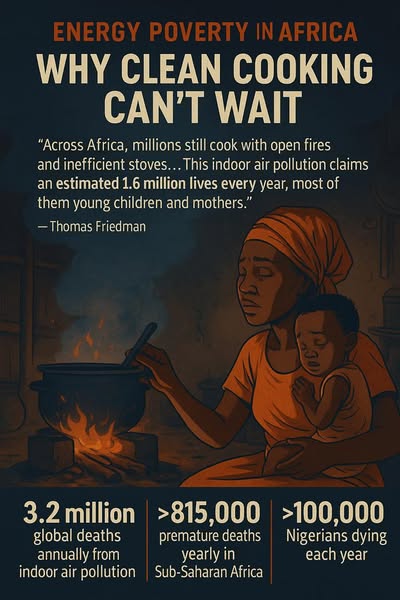

“Across Africa, millions still cook with open fires and inefficient stoves… This indoor air pollution claims an estimated 1.6 million lives every year, most of them young children and mothers.” — Majid Ezzati (2008).

That warning mirrors what the latest health data shows. Household (indoor) air pollution kills about 3.2 million people globally each year—including more than 237,000 children under five—because families still cook with wood, charcoal, kerosene, and coal in poorly ventilated spaces.
Africa bears a heavy share of this burden. Recent analyses estimate ~815,000 premature deaths annually in Sub-Saharan Africa linked to dirty cooking fuels and technologies. Earlier WHO/AFRO figures showed ~639,000 deaths in the African Region in 2019 from household air pollution alone.
Nigeria is on the front line. Independent assessments indicate that over 100,000 Nigerians die each year from diseases linked to household air pollution—making clean cooking not just a climate or energy issue, but an urgent public-health and women’s empowerment priority.
What we’re doing

Under the Renewed Hope Agenda of President Bola Ahmed Tinubu, GCFR, the Federal Ministry of Innovation, Science & Technology is driving a whole-of-government push to end Nigeria’s dependence on smoky cooking:
• Sustainable Energy Access Programme (SEAP): Scaling affordable clean cooking solutions (LPCNG where appropriate, improved biomass stoves, ethanol and biogas) so households can switch safely and quickly.
• Financing & delivery at scale: Building an investment pipeline that blends public, development, private and carbon finance to de-risk early projects and reach millions of homes.
• Data-driven targeting: Using new national datasets and monitoring to track adoption, health outcomes, and affordability so support reaches the most vulnerable first.
Clean cooking means fewer children struggling with pneumonia, fewer mothers exposed to toxic smoke during hours of meal preparation, fewer emergency hospital visits, and less pressure on forests and household budgets. This is health care, climate action, and economic relief—delivered through the kitchen.